Ever heard of Myers-Briggs? It's a personality test that determines a general archetype of your personality, categorized into four distinct parts that ultimately creates 16 different molds of human character, each with varying degrees of intensity. These different categories reflect the choices you as a person will tend to make in your everyday lives - and that naturally includes playing trading card games. In fact, I can generally tell what kind of character a person has based on the deck they choose to run and the way they run that deck.
 |
| Be prepared for a lot of Saki references... |
Please keep in mind that these are just generalizations and you do not have to conform entirely to a certain mold to be able to be classified by the mold. We're talking about a spectrum of players here, and I'm just discussing the extreme ends. More than likely, you'll fall into some middling range between the two (like 80/20 Digital, which is where I'm at).
Digital Players
are players who calculate everything. The world is full of numbers and equations, and in their minds is a set of LED displays that list out a variety of values. The number of cards in deck. The ratio of monsters to spells to items to impacts. The ratios of Size 1 to Size 2 to Size 3. They use numbers to get a logical foothold on any situation, taking very calculated measures of play. Odds and percentages are very important, and 50% is the golden line - if I have more than a 50% of gaining, then the risk is worth it.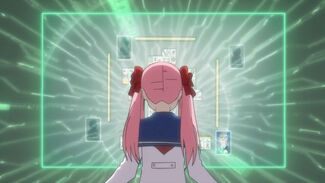 |
| Brain too strong, please nerf |
Digital players care a lot about numbers and what they mean. They rationalize through everything and choose the best-case-scenario every time. A digital player often sees a cardgame from a grand-perspective, meaning the entire game as a whole. A deck is taken in the context of the values it contains and not the performance of a few games. Digital players understand that a thousand games may not be enough to truly determine whether something works well or doesn't. Digital players have one set playstyle that they rarely deviate from because it works.
 |
| Nodoka: Impossible! Me: Not in anime... |
Occult Players
on the other hand, have a touchy-feely approach. There's a lot that can't be measured or understood, and occult players have a sense that some things just have to be felt out. Instead of their brains, they use their guts. Sensitive to the slightest change in situation, occult players notice small things and take them as signs or indicators of other things. Most importantly, they do whatever feels right, not necessarily needing an explanation. If it works, it works.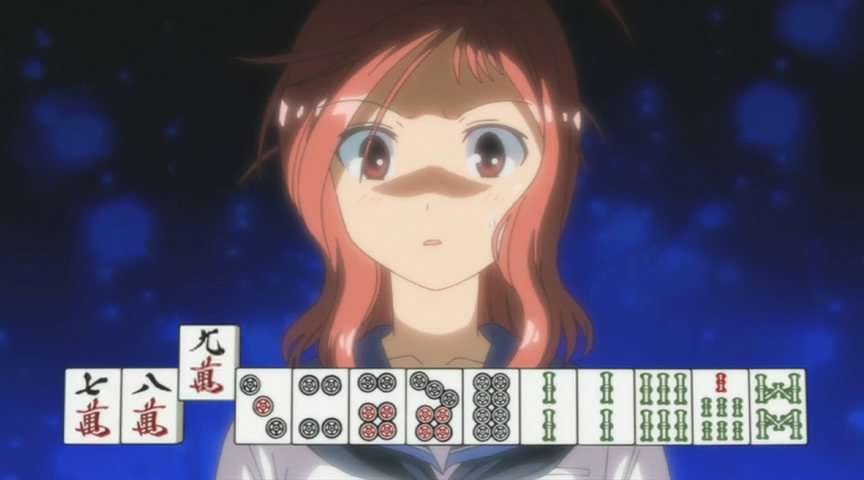 |
| It's always a sign |
As much as most occult players hate to admit, they do believe in the heart of the cards. Topdeck is legit and fate is real. Occult players also take any chance they can. If there's even a remote possibility it will work, an occult player will flirt with the idea. They have a case-by-case, game-by-game perspective that is heavily influenced by emotion, instinct, and coincidence. They highly value the results of every single game. Occult players also tend to stick to one playstyle, but this one playstyle is often different for each deck or game.
 |
| Dumbest. Idiot. Ever. |
Which side is better?
Ahahaha. Don't make me answer this.
As with most binary
comparisons, there are advantages and disadvantages to both sides.
Digital players, on average, tend to be smarter and better educated.
Decks and strategies that they create are often imitated by players
everywhere. However, they tend to have really poor tournament results or
showings, though this might be a rule of numbers. By the way, all card
game creators are digital people; this is a given. Occult players, on
average, are less educated and mature, often younger both physically and
mentally. Their main goal in card games is to have fun and enjoy
themselves, though winning is a nice result. Speaking of results, these
players (to the dismay of many) often top at tournaments, at least a lot
more than they really should. There's a reason why, and I'll explain in
a minute.
 |
| Rinshan every game. Disgusting. |
But a digital brain
will only get you so far, and this is because our world is not a
digital world. Yeah, sure, the fundamental structure of the universe is
based in math and physical properties. But get this: at the subatomic
level, the universe actually relies on a heavy RNG-based operation known
as quantum mechanics. In other words, our world cannot be fully
calculated. You can't always rely on facts - you have to take chances.
And that's where an occult player will shine. Because our world is so
biased towards the circumstance, an occult player that notices these
coincidences will be better suited to adapt and to make ridiculous plays
that just happen to work. Call it fate, luck, hax, or whatever, but the
result will be history.
 |
| The epitome of digital/occult hybrid perfection |
But the main problem is with the occult players. Occult players need to listen!
They need to stop plugging their ears and come out of the rock they are
hiding under. They need to learn more about the world and the facts and
the reality. Occult players need to do some math and testing for
once and actually justify their beliefs with reason. They need to stop
saying "I feel" and "I think" and start saying "I know". Superstition is
just ignorance. Denial is just stupidity. And refusal to improve and
learn is just damned laziness.
I believe the
perfect balance is this: keep a digital mindset when deckbuilding and
testing, but adopt an slightly more occult-oriented style at any
tournament. In other words, do your research and do your math, but don't
be afraid to make plays and take risks when the time comes. You have an
eternity to deckbuild and to test, but you only have one shot at any
tournament. The worst that can happen is that you regret your decisions,
so play in a way that you know you will never regret. If you do this,
even if you don't win you'll still come out a winner.


0 comments:
Post a Comment